Cuts and Waterproof Dressings: 7 Questions Every Small Food Business Should Ask
Practical UK guidance on cuts, sores and waterproof dressings for food handlers, including reporting, hygiene controls and food safety records.
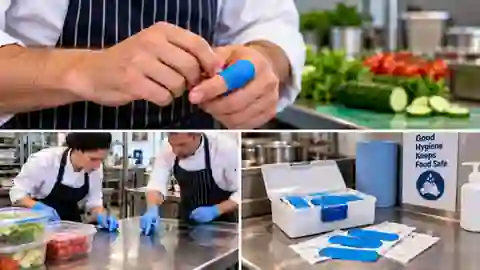
A small cut can become a food safety issue
You're halfway through preparing lunch service when a member of staff catches their finger on the edge of a tin.
It's a small cut. They wash it, put on a plaster and want to carry on working.
For a food business, the important questions are: is the wound properly covered, is the dressing suitable, does the manager need to know, and is there any risk that food has already been contaminated?
Food Standards Agency guidance says cuts and sores should be completely covered with a waterproof dressing, ideally a brightly coloured one. The reason is practical: it helps prevent bacteria from the cut or sore spreading to food, while a brightly coloured dressing is easier to spot if it comes off.
Here are seven questions every small food business should consider.
1. Why do cuts and sores matter in food preparation?
A small cut might seem insignificant, particularly during a busy service.
The problem isn't simply the presence of the cut. It's the possibility that bacteria from damaged skin, an infected wound or a sore could reach food, food-contact surfaces or equipment.
Hands are involved in almost every part of food preparation. They touch utensils, fridge handles, containers, chopping boards, packaging and ready-to-eat food.
Good food safety management therefore needs to include sensible personal hygiene controls.
GOV.UK guidance says staff must tell their manager if they're unwell and must not handle food or enter a food handling area if they have infected wounds or sores, along with certain other illnesses or symptoms that could create a food safety risk.
That distinction matters. A small, clean cut that can be safely covered isn't necessarily the same situation as an infected wound.
Managers need to consider the condition of the wound, the work being carried out and whether food could be contaminated.
For businesses reviewing wider kitchen controls, our guide to preventing cross-contamination between raw and ready-to-eat food explains how contamination can move through hands, equipment and preparation areas.
2. What type of dressing should food handlers use?
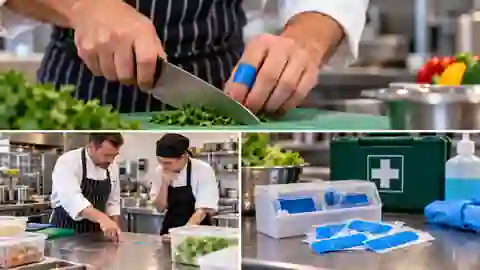
For cuts and sores that can safely be covered, FSA guidance recommends a brightly coloured waterproof dressing.
In many commercial kitchens, blue dressings are commonly used because blue is relatively unusual in food and is easier to notice if the dressing becomes detached.
The important features are practical:
- the wound is completely covered
- the dressing is waterproof
- it remains secure during the task
- it can be seen easily if it becomes detached
- it stays clean and in good condition
A normal skin-coloured household plaster isn't the best choice for food preparation because it can be much harder to see if it comes off.
3. Does the manager need to know about every cut?
Staff should be encouraged to report cuts and sores rather than quietly covering them and carrying on.
FSA Safer Food, Better Business guidance tells staff to inform their manager if they have cuts or sores. That gives the manager the opportunity to make a sensible decision.
| Situation | Practical response |
|---|---|
| Small clean cut on a finger | Clean it and completely cover it with a suitable waterproof dressing |
| Dressing becomes loose | Stop the task and replace it |
| Dressing can't completely cover the wound | Keep the person away from exposed food until the risk can be controlled |
| Cut or sore appears infected | Report it to the manager and assess fitness to work |
| Dressing is discovered missing | Stop and investigate whether it could have entered food |
| Food may have been contaminated | Isolate affected food and decide on appropriate corrective action |
The exact action will depend on the circumstances. What shouldn't happen is simply ignoring the problem because the kitchen is busy.
4. Should staff wear gloves over a dressing?
Gloves can sometimes provide another physical barrier, particularly when the cut is on the hand.
But gloves don't replace good hand hygiene or the need for a proper waterproof dressing. Staff can contaminate gloves in exactly the same way they contaminate their hands.
If gloves are used, they need to be changed when appropriate, and hands still need to be washed properly.
GOV.UK guidance says anyone who works with food must wash their hands at key points including before preparing food, after touching raw food, after handling waste, after cleaning, after touching the face or hair, and after using the toilet.
A sensible sequence after dealing with a minor cut might be:
Stop food handling
Move away from exposed food and food-contact equipment before dealing with the wound.
Deal with the cut
Clean and appropriately treat the wound.
Apply the dressing
Completely cover the area with a secure, brightly coloured waterproof dressing.
Wash your hands
Wash and dry hands thoroughly before returning to food preparation.
Use gloves if appropriate
If your procedure requires gloves for that task, put on a clean pair after handwashing. Don't use gloves as a substitute for the dressing.
These controls are particularly important where staff are handling ready-to-eat foods that won't receive a further cooking step.
Small cafés may also find our food safety guidance for cafés useful when reviewing everyday personal hygiene and food preparation routines.
5. What happens if the dressing falls off?
This is where a simple personal hygiene issue can turn into a corrective action.
If a staff member notices that their dressing is missing, food preparation should stop while the situation is investigated. Don't simply apply another dressing and continue.
Think about:
- when the dressing was last definitely in place
- which foods the person handled
- which work surfaces or equipment they touched
- whether the dressing could have entered an open container or prepared food
- whether potentially affected food should be discarded
- whether surfaces and equipment need cleaning and disinfection
If the dressing is found quickly on the floor or inside a glove, the situation may be straightforward. If it can't be found, the uncertainty is greater.

6. What should the business record?
Not every minor cut needs pages of paperwork. Your records should be proportionate and useful.
The business may need evidence that staff have been trained in its personal hygiene procedures. GOV.UK says businesses must be able to show staff have the right skills and up-to-date training for their role, and recommends keeping records of completed training.
If something goes wrong, the record becomes more important.
For example, if a dressing falls off and potentially contaminates food, you may want to record:
- the date and time
- what happened
- the food or area affected
- what immediate action was taken
- whether food was discarded
- whether equipment or surfaces were cleaned and disinfected
- whether the member of staff needed retraining or further supervision
- what was changed to reduce the chance of it happening again
That sort of information makes HACCP records useful. It shows more than the fact that a problem occurred. It shows what the business did about it.
If you're preparing for an inspection, our guide to food safety records you should have ready explains why completed records and corrective actions are more useful than folders containing unchecked paperwork.
7. How can digital food safety records help?
The underlying food safety control doesn't change because the record is digital.
Staff still need to report cuts and sores. Managers still need to assess problems. Corrective action still needs to be sensible.
What changes is how the information is kept.
With digital food safety records, relevant checks and corrective actions can be entered digitally and stored with the rest of the business's food safety information. That can make it easier to look back later.
For example, if a supervisor wants to check whether a personal hygiene issue has happened before, a centralised record history is generally easier to work through than several paper folders.
The app doesn't decide whether someone is fit to work and it doesn't guarantee compliance. It's a record-keeping tool.
If replacing some of your paper records would make everyday checks easier to manage, you can start your free demo and see whether digital record keeping suits your business.
Common mistakes with cuts and waterproof dressings
Using an unsuitable plaster
A household dressing may not be waterproof or easily visible if it falls into food.
Failing to report the wound
Managers can't assess a risk they don't know about.
Covering an infected wound and carrying on
A dressing doesn't automatically make an infected wound safe for food handling.
Using gloves instead of a dressing
Gloves can become damaged or contaminated and aren't a substitute for properly covering the wound.
Ignoring a missing dressing
If it can't be found, food or equipment may need to be treated as potentially contaminated.
A short personal hygiene check for managers
Cuts and waterproof dressings
- Do staff know they must report cuts and sores?
- Do you keep suitable brightly coloured waterproof dressings available?
- Are wounds completely covered before food handling starts?
- Do managers know what to do if a wound appears infected?
- Do staff know that gloves don't replace handwashing?
- Is there a clear procedure if a dressing becomes loose or goes missing?
- Would you record a significant failure and the corrective action taken?
- Are personal hygiene procedures included in staff training?
Frequently asked questions
Do food handlers need to use blue plasters?
FSA guidance recommends brightly coloured waterproof dressings because they're easier to see if they fall into food. Blue is commonly used in food businesses for this reason.
Can someone work with a cut on their hand?
A minor cut may be manageable if it is properly treated and completely covered with a suitable waterproof dressing. An infected wound or sore is different and must be reported so the business can assess whether the person is fit to handle food.
Should you put a glove over a blue plaster?
It can provide an additional barrier for some tasks, but a glove doesn't replace a waterproof dressing or proper handwashing. Gloves also need to be changed when they become contaminated or damaged.
What should I do if a blue plaster falls off during food preparation?
Stop the task and establish where the dressing has gone. Check the food, preparation area and equipment that may have been affected. If you can't rule out contamination, take appropriate corrective action rather than simply replacing the dressing and continuing.
Make the simple controls routine
Cuts and waterproof dressings aren't complicated, but they're exactly the type of small issue that can be overlooked during a busy service.
Make sure suitable dressings are always available, staff know when to report a wound, managers understand the difference between a minor cut and an infected sore, and everyone knows what to do if a dressing goes missing.
Where a problem or corrective action needs recording, keeping it with your other digital food safety records makes the history easier to retrieve than another loose sheet in a folder.
Start your free demo