Power Cuts: 7 Questions Every Small Food Business Should Ask
Power cut in your café, takeaway or restaurant? Learn what to check, when to stop service and how to record food safety decisions before reopening.

The power's gone off. What needs to happen first?
It's nearly lunchtime. Your café's sandwich fridge has stopped humming, the dishwasher won't run and there's a pan of soup on an electric hob. Customers are waiting, and nobody knows when the electricity will return.
Your first food safety management decision is to pause affected work, keep fridge and freezer doors closed and establish what you can still control safely. Note when the outage started, put someone in charge and keep food with an uncertain storage history out of service while you assess it.
A short outage doesn't automatically mean throwing everything away. It doesn't give you permission to carry on as normal either. These seven questions help you make decisions you can explain afterwards.
1. Do we know when the power failed and what's affected?
An outage during service is easier to time than one discovered at opening. Record the known start time, or the earliest point at which power might have failed. Don't turn an estimate into a definite time.
Check more than the fridges. Electric cooking equipment, hot holding, extraction, lighting, hot water and washing facilities may all be affected. Food already being cooked or cooled needs its own assessment.
Give staff clear instructions about which tasks have stopped and who can authorise food for use. Tell delivery staff if you can't safely receive chilled or frozen stock.
If you discover the outage in the morning, yesterday's closing temperature is useful background. It doesn't establish what happened overnight.
2. What do our temperatures actually tell us?
The GOV.UK business chilling guidance states that cold food must generally be kept at 8°C or below in England, Wales and Northern Ireland. It recommends setting fridges at 5°C or below to allow for fluctuations. Follow stricter product storage instructions where they apply.
Scotland has its own regulatory framework. Use the procedures applicable to your business and seek advice from your local authority's food safety team if you're unsure how to assess affected stock.
Keep doors closed between planned checks. Use a suitable, checked thermometer and an appropriate hygienic method. Distinguish a cabinet air reading from a food temperature. A display that has gone blank tells you nothing about the food, and a display that comes back on shows only the current reading.
Useful evidence includes:
- The last satisfactory check before the outage.
- The time and location of each new reading.
- Whether you measured food or cabinet air.
- Which foods and storage units were affected.
- Any gaps in the temperature history.
For wider equipment checks, see our guide to broken fridge seals and food safety.
See the scope of the FSA's consumer power-cut advice.

3. Can we protect stock without creating another risk?
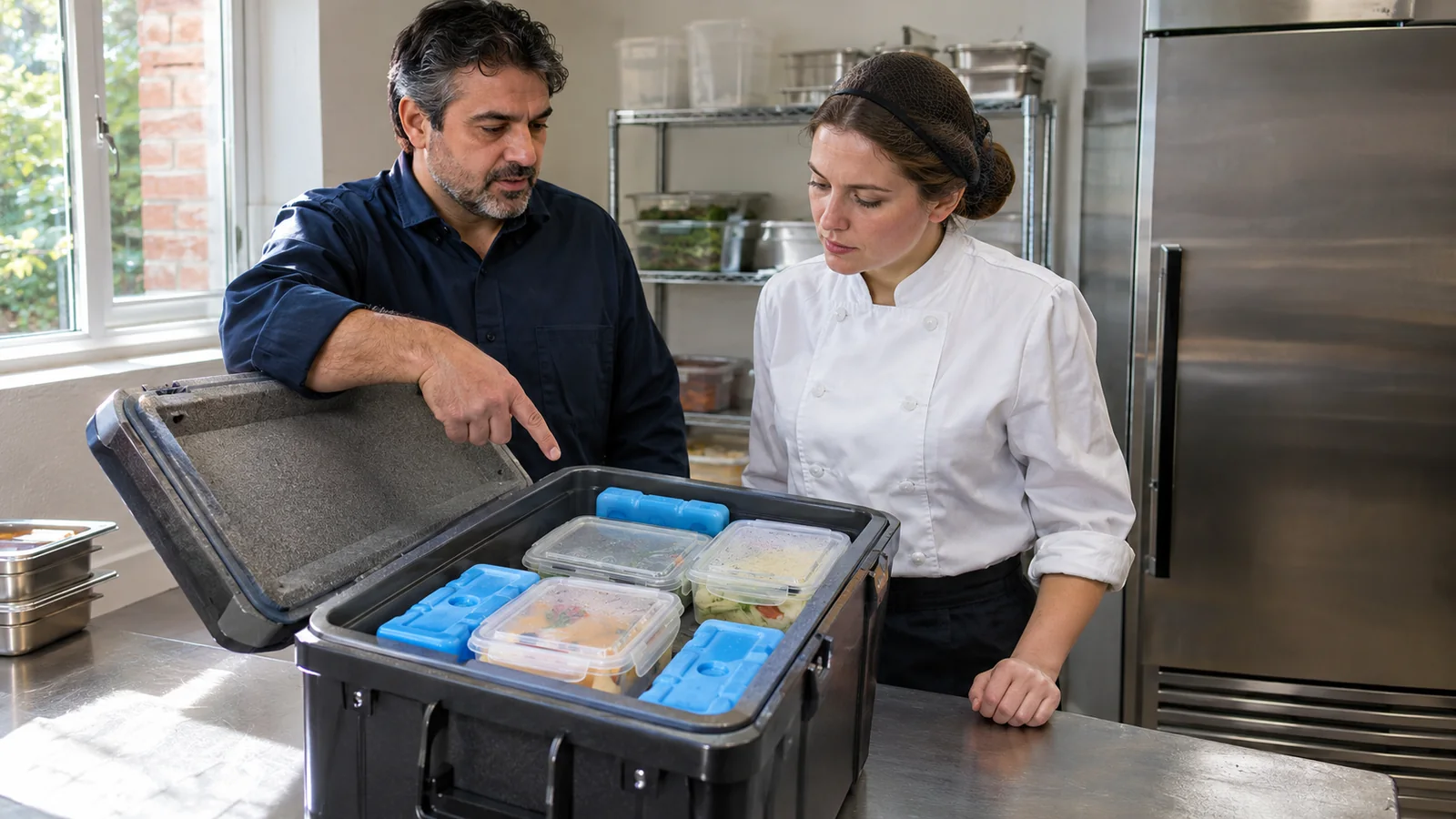
Moving food can help if suitable alternative refrigeration is available. Plan the transfer before opening the affected unit. Check that the destination is operating correctly and has enough space, and protect food during transport.
Keep raw food separate from ready-to-eat food. Retain labels, use-by dates and identification so you can trace what moved and decide how it should be used.
| Situation | Practical response |
|---|---|
| Alternative refrigeration is available | Check capacity and temperature, then transfer suitable stock promptly and record its destination. |
| No safe chilled storage is available | Stop accepting affected deliveries and assess existing stock under your incident procedure. |
| Frozen food has started thawing | Assess its condition, temperature history and product instructions before deciding what to do. |
| Storage history is uncertain | Keep stock out of use while a competent person assesses it; discard it if safety can't be established. |
Don't put thawing food back in a freezer simply to make it look unaffected. Refreezing isn't a safety reset. Equally, a cold reading after the power returns can't reconstruct an unknown history.
4. Can we still prepare and serve food safely?
A working gas hob doesn't establish that a kitchen can operate safely. You also need suitable hygiene facilities, safe equipment operation, adequate ventilation and enough light to work properly.
Ask whether staff can wash their hands, clean and disinfect utensils, prevent cross-contamination and control cooking and holding temperatures. Stop affected operations if those controls can't be maintained. That may mean suspending the whole service.
For food in hot holding, the GOV.UK guidance on keeping food hot describes a general requirement of 63°C or above, with specific exceptions. If holding fails, follow your established corrective-action procedure using the known time and temperature history. Don't assume reheating makes every affected batch safe.
Part-cooked food needs assessment too. Don't restart an interrupted cooking process hours later without a safe, established method. Our article on core temperature checks explains why a surface appearance or equipment setting isn't enough.
5. What should our HACCP records show?
Your HACCP records should explain the incident, the decisions and the checks that followed. HACCP means identifying food safety hazards and setting controls to manage them. A corrective action is what you do when a control fails.
The FSA's record-keeping guidance says documentation should suit the size and nature of the business and help verify that controls are maintained. There's no need to write a lengthy report for every minor interruption, but “power cut, sorted” explains very little.
Record enough detail to identify:
- When the outage started and ended, including uncertainty.
- Affected equipment, foods and batches.
- Temperature readings and their times.
- Food held back, transferred or discarded, with reasons.
- Advice received, who gave it and when.
- The person responsible for decisions and follow-up checks.
For example, “Lunch prep stopped; cooked chicken held out of use because overnight temperature history couldn't be established” explains the decision. Add the actual times, quantities and final action from your incident. Don't copy example details into a real record.
Our guide to food safety records for an inspection covers keeping evidence useful and accessible.
6. Who decides when normal service can restart?
Name the person responsible for reopening affected operations. The power returning is the start of the recovery checks, rather than proof that recovery is complete.
Confirm that refrigeration has recovered, food has been assessed, cleaning and handwashing facilities work, and any affected cooking or hot-holding process is safe to resume. Check that staff know which stock remains out of use.
Don't release uncertain food because it smells normal, mix it with unaffected batches or rewrite missed readings as if someone took them. Record gaps honestly.
For business-specific advice, contact your local authority's food safety team. Dundee City Council's business guidance, for example, stresses physically checking temperatures and closing where adequate temperature control can't be maintained. Follow advice relevant to your own premises and circumstances.
7. What will make the next outage easier to manage?
Once immediate risks are controlled, review what caused delays. Perhaps nobody knew where the probe was, the backup fridge was full or only the owner could authorise disposal.
Update your incident procedure with responsibilities, contact details, storage options and restart checks. Brief staff so the response doesn't depend on one person being on shift.
HACCP Records can support digital corrective-action records, keep incident history centrally and make previous entries easier to retrieve. Digital food safety records help you compare recurring problems without searching separate paper folders. They don't make the safety decision for you.
Because the service is accessed online, plan how you'll capture essential details if power or connectivity is unavailable. A temporary written note can be transferred afterwards, preserving the original event times and identifying any later entry honestly.
A short power-cut checklist
Before you resume affected work
- Record the outage times and any uncertainty.
- Keep doors closed between necessary checks and record reliable readings.
- Assess affected stock and keep uncertain food out of use.
- Confirm cooking, storage, handwashing and cleaning controls work.
- Record disposal, transfers, advice and the responsible person's restart decision.
- Review the incident and brief staff on any changes.